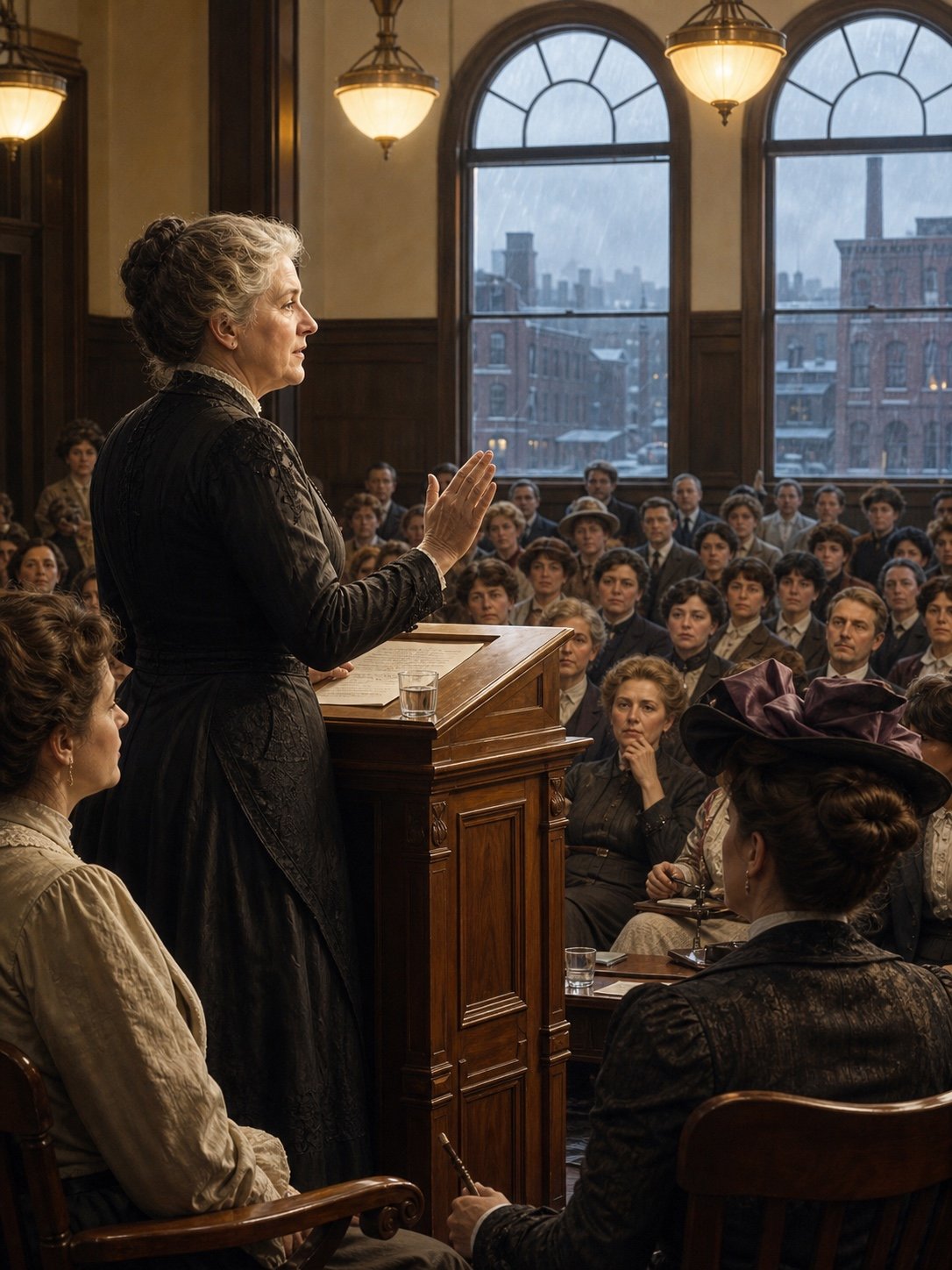
XI. THE WIDENING SUFFRAGE STREAM
In my chapters on Miss Anthony I bridged the twenty years between 1886 and 1906, omitting many of the stirring suffrage events of that long period, in my desire to concentrate on those which most vitally concerned her. I must now retrace my steps along the widening suffrage stream and describe, consecutively at least, and as fully as these incomplete reminiscences will permit, other incidents that occurred on its banks.
Of these the most important was the union in 1889 of the two great suffrage societies—the American Association, of which Lucy Stone was the president, and the National Association, headed by Susan B. Anthony and Elizabeth Cady Stanton. At a convention held in Washington these societies were merged as The National American Woman Suffrage Association—the name our association still bears—and Mrs. Stanton was elected president. She was then nearly eighty and past active work, but she made a wonderful presiding officer at our subsequent meetings, and she was as picturesque as she was efficient.
Miss Anthony, who had an immense admiration for her and a great personal pride in her, always escorted her to the capital, and, having worked her utmost to make the meeting a success, invariably gave Mrs. Stanton credit for all that was accomplished. She often said that Mrs. Stanton was the brains of the new association, while she herself was merely its hands and feet; but in truth the two women worked marvelously together, for Mrs. Stanton was a master of words and could write and speak to perfection of the things Susan B. Anthony saw and felt but could not herself express. Usually Miss Anthony went to Mrs. Stanton's house and took charge of it while she stimulated the venerable president to the writing of her annual address. Then, at the subsequent convention, she would listen to the report with as much delight and pleasure as if each word of it had been new to her. Even after Mrs. Stanton's resignation from the presidency—at the end, I think, of three years—and Miss Anthony's election as her successor, "Aunt Susan" still went to her old friend whenever an important resolution was to be written, and Mrs. Stanton loyally drafted it for her.
Mrs. Stanton was the most brilliant conversationalist I have ever known; and the best talk I have heard anywhere was that to which I used to listen in the home of Mrs. Eliza Wright Osborne, in Auburn, New York, when Mrs. Stanton, Susan B. Anthony, Emily Howland, Elizabeth Smith Miller, Ida Husted Harper, Miss Mills, and I were gathered there for our occasional week-end visits. Mrs. Osborne inherited her suffrage sympathies, for she was the daughter of Martha Wright, who, with Mrs. Stanton and Lucretia Mott, called the first suffrage convention in Seneca Falls, New York. I must add in passing that her son, Thomas Mott Osborne, who is doing such admirable work in prison reform at Sing Sing, has shown himself worthy of the gifted and high-minded mother who gave him to the world.
Most of the conversation in Mrs. Osborne's home was contributed by Mrs. Stanton and Miss Anthony, while the rest of us sat, as it were, at their feet. Many human and feminine touches brightened the lofty discussions that were constantly going on, and the varied characteristics of our leaders cropped up in amusing fashion. Mrs. Stanton, for example, was rarely accurate in giving figures or dates, while Miss Anthony was always very exact in such matters. She frequently corrected Mrs. Stanton's statements, and Mrs. Stanton usually took the interruption in the best possible spirit, promptly admitting that "Aunt Susan" knew best. On one occasion I recall, however, she held fast to her opinion that she was right as to the month in which a certain incident had occurred.
"No, Susan," she insisted, "you're wrong for once. I remember perfectly when that happened, for it was at the time I was beginning to wean Harriet."
Aunt Susan, though somewhat staggered by the force of this testimony, still maintained that Mrs. Stanton must be mistaken, whereupon the latter repeated, in exasperation, "I tell you it happened when I was weaning Harriet." And she added, scornfully, "What event have you got to reckon from?"
Miss Anthony meekly subsided.
Mrs. Stanton had wonderful blue eyes, which held to the end of her life an expression of eternal youth. During our conventions she usually took a little nap in the afternoon, and when she awoke her blue eyes always had an expression of pleased and innocent surprise, as if she were gazing on the world for the first time—the round, unwinking, interested look a baby's eyes have when something attractive is held up before them.
Let me give in a paragraph, before I swing off into the bypaths that always allure me, the consecutive suffrage events of the past quarter of a century. Having done this, I can dwell on each as casually as I choose, for it is possible to describe only a few incidents here and there; and I shall not be departing from the story of my life, for my life had become merged in the suffrage cause.
Of the preliminary suffrage campaigns in Kansas, made in company with "Aunt Susan," I have already written, and it remains only to say that during the second Kansas campaign yellow was adopted as the suffrage color. In 1890, '92, and '93 we again worked in Kansas and in South Dakota, with such indefatigable and brilliant speakers as Mrs. Catt (to whose efforts also were largely due the winning of Colorado in '93), Mrs. Laura Johns of Kansas, Mrs. Julia Nelson, Henry B. Blackwell, Dr. Helen V. Putnam of Dakota, Mrs. Emma Smith DeVoe, Rev. Olympia Browne of Wisconsin, and Dr. Mary Seymour Howell of New York. In '94, '95, and '96 special efforts were devoted to Idaho, Utah, California, and Washington, and from then on our campaigns were waged steadily in the Western states.
The Colorado victory gave us two full suffrage states, for in 1869 the Territory of Wyoming had enfranchised women under very interesting conditions, not now generally remembered. The achievement was due to the influence of one woman, Esther Morris, a pioneer who was as good a neighbor as she was a suffragist. In those early days, in homes far from physicians and surgeons, the women cared for one another in sickness, and Esther Morris, as it happened, once took full and skilful charge of a neighbor during the difficult birth of the latter's child. She had done the same thing for many other women, but this woman's husband was especially grateful. He was also a member of the Legislature, and he told Mrs. Morris that if there was any measure she wished put through for the women of the territory he would be glad to introduce it. She immediately took him at his word by asking him to introduce a bill enfranchising women, and he promptly did so.
The Legislature was Democratic, and it pounced upon the measure as a huge joke. With the amiable purpose of embarrassing the Governor of the territory, who was a Republican and had been appointed by the President, the members passed the bill and put it up to him to veto. To their combined horror and amazement, the young Governor did nothing of the kind. He had come, as it happened, from Salem, Ohio, one of the first towns in the United States in which a suffrage convention was held. There, as a boy, he had heard Susan B. Anthony make a speech, and he had carried into the years the impression it made upon him. He signed that bill; and, as the Legislature could not get a two-thirds vote to kill it, the disgusted members had to make the best of the matter. The following year a Democrat introduced a bill to repeal the measure, but already public sentiment had changed and he was laughed down. After that no further effort was ever made to take the ballot away from the women of Wyoming.
When the territory applied for statehood, it was feared that the woman-suffrage clause in the constitution might injure its chance of admission, and the women sent this telegram to Joseph M. Carey:
"Drop us if you must. We can trust the men of Wyoming to enfranchise us after our territory becomes a state."
Mr. Carey discussed this telegram with the other men who were urging upon Congress the admission of their territory, and the following reply went back:
"We may stay out of the Union a hundred years, but we will come in with our women."
There is great inspiration in those two messages—and a great lesson, as well.
In 1894 we conducted a campaign in New York, when an effort was made to secure a clause to enfranchise women in the new state constitution; and for the first time in the history of the woman-suffrage movement many of the influential women in the state and city of New York took an active part in the work.Miss Anthony was, as always, our leader and greatest inspiration.Mrs.John Brooks Greenleaf was state president, and Miss Mary Anthony was the most active worker in the Rochester headquarters.Mrs.Lily Devereaux Blake had charge of the campaign in New York City, and Mrs.Marianna Chapman looked after the Brooklyn section, while a most stimulating sign of the times was the organization of a committee of New York women of wealth and social influence, who established their headquarters at Sherry's.Among these were Mrs.Josephine Shaw Lowell, Mrs.Joseph H.Choate, Dr.Mary Putnam Jacobi, Mrs.J.Warren Goddard, and Mrs.Robert Abbe.Miss Anthony, then in her seventy-fifth year, spoke in every county of the state sixty in all.I spoke in forty, and Mrs.Catt, as always, made a superb record.Miss Harriet May Mills, a graduate of Cornell, and Miss Mary G.
Hay, did admirable organization work in the different counties.Our disappointment over the result was greatly soothed by the fact that only two years later both Idaho and Utah swung into line as full suffrage states, though California, in which we had labored with equal zeal, waited fifteen years longer.
Among these campaigns, and overlapping them, were our annual conventions—each of which I attended from 1888 on—and the national and international councils, to a number of which, also, I have given preliminary mention. When Susan B. Anthony died in 1906, four American states had granted suffrage to woman. At the time I write—1914—the result of the American women's work for suffrage may be briefly tabulated thus:
SUFFRAGE STATUS
FULL SUFFRAGE FOR WOMEN
Number of
State Year Won Electoral Votes
Wyoming 1869 3
Colorado 1893 6
Idaho 1896 4
Utah 1896 4
Washington 1910 7
California 1911 13
Arizona 1912 3
Kansas 1912 10
Oregon 1912 5
Alaska 1913 —
Nevada 1914 3
Montana 1914 4