CHAPTER XV.
JAMES NASMYTH.
"By Hammer and Hand
All Arts doth stand."
Hammermen's Motto.
The founder Of the Scotch family of Naesmyth is said to have derived his name from the following circumstance.In the course of the feuds which raged for some time between the Scotch kings and their powerful subjects the Earls of Douglas, a rencontre took place one day on the outskirts of a Border village, when the king's adherents were worsted.One of them took refuge in the village smithy, where, hastily disguising himself, and donning a spare leathern apron, he pretended to be engaged in assisting the smith with his work, when a party of the Douglas followers rushed in.They glanced at the pretended workman at the anvil, and observed him deliver a blow upon it so unskilfully that the hammer-shaft broke in his hand.On this one of the Douglas men rushed at him, calling out, "Ye're nae smyth!" The assailed man seized his sword, which lay conveniently at hand, and defended himself so vigorously that he shortly killed his assailant, while the smith brained another with his hammer; and, a party of the king's men having come to their help, the rest were speedily overpowered.The royal forces then rallied, and their temporary defeat was converted into a victory.
The king bestowed a grant of land on his follower "Nae Smyth," who assumed for his arms a sword between two hammers with broken shafts, and the motto "Non arte sed Marte," as if to disclaim the art of the Smith, in which he had failed, and to emphasize the superiority of the warrior.Such is said to be the traditional origin of the family of Naesmyth of Posso in Peeblesshire, who continue to bear the same name and arms.
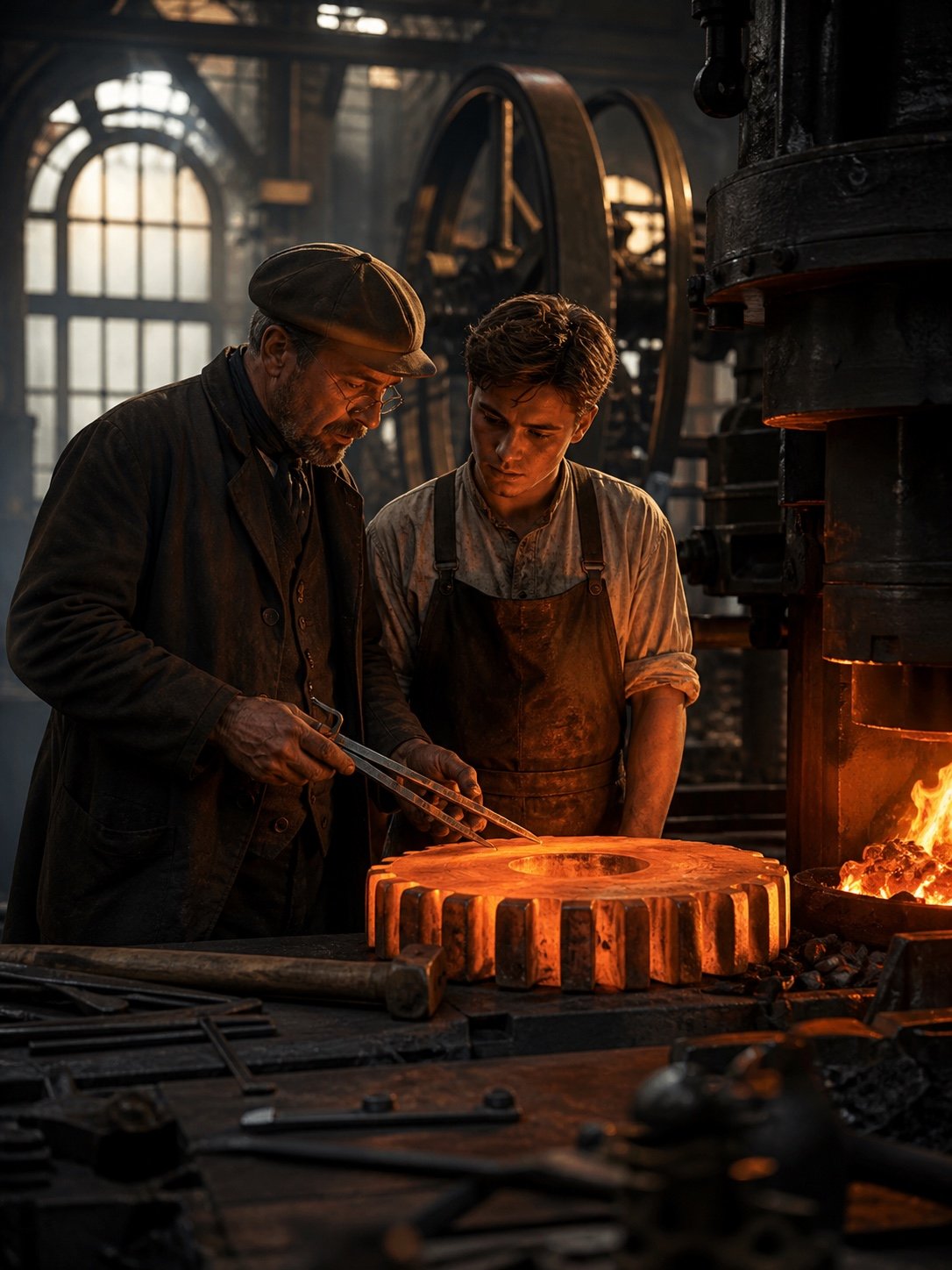
It is remarkable that the inventor of the steam-hammer should have so effectually contradicted the name he bears and reversed the motto of his family; for so far from being "Nae Smyth," he may not inappropriately be designated the very Vulcan of the nineteenth century. His hammer is a tool of immense power and pliancy, but for which we must have stopped short in many of those gigantic engineering works which are among the marvels of the age we live in. It possesses so much precision and delicacy that it will chip the end of an egg resting in a glass on the anvil without breaking it, while it delivers a blow of ten tons with such a force as to be felt shaking the parish. It is therefore with a high degree of appropriateness that Mr. Nasmyth has discarded the feckless hammer with the broken shaft, and assumed for his emblem his own magnificent steam-hammer, at the same time reversing the family motto, which he has converted into "Non Marte sed Arte."
James Nasmyth belongs to a family whose genius in art has long been recognised.His father, Alexander Nasmyth of Edinburgh, was a landscape-painter of great eminence, whose works are sometimes confounded with those of his son Patrick, called the English Hobbema, though his own merits are peculiar and distinctive.The elder Nasmyth was also an admirable portrait painter, as his head of Burns—the best ever painted of the poet—bears ample witness.His daughters, the Misses Nasmyth, were highly skilled painters of landscape, and their works are well known and much prized.James, the youngest of the family, inherits the same love of art, though his name is more extensively known as a worker and inventor in iron.He was born at Edinburgh, on the 19th of August, 1808; and his attention was early directed to mechanics by the circumstance of this being one of his father's hobbies.Besides being an excellent painter, Mr.Nasmyth had a good general knowledge of architecture and civil engineering, and could work at the lathe and handle tools with the dexterity of a mechanic.
He employed nearly the whole of his spare time in a little workshop which adjoined his studio, where he encouraged his youngest son to work with him in all sorts of materials.Among his visitors at the studio were Professor Leslie, Patrick Miller of Dalswinton, and other men of distinction.He assisted Mr.Miller in his early experiments with paddle-boats, which eventually led to the invention of the steamboat.It was a great advantage for the boy to be trained by a father who so loved excellence in all its forms, and could minister to his love of mechanics by his own instruction and practice.James used to drink in with pleasure and profit the conversation which passed between his father and his visitors on scientific and mechanical subjects; and as he became older, the resolve grew stronger in him every day that he would be a mechanical engineer, and nothing else.At a proper age, he was sent to the High School, then as now celebrated for the excellence of its instruction, and there he laid the foundations of a sound and liberal education.But he has himself told the simple story of his early life in such graphic terms that we feel we cannot do better than quote his own words:—[1]
"I had the good luck," he says, "to have for a school companion the son of an iron founder.Every spare hour that I could command was devoted to visits to his father's iron foundry, where I delighted to watch the various processes of moulding, iron-melting, casting, forging, pattern-making, and other smith and metal work; and although I was only about twelve years old at the time, I used to lend a hand, in which hearty zeal did a good deal to make up for want of strength.I look back to the Saturday afternoons spent in the workshops of that small foundry, as an important part of my education.I did not trust to reading about such and such things; I saw and handled them; and all the ideas in connection with them became permanent in my mind.I also obtained there—what was of much value to me in after life—a considerable acquaintance with the nature and characters of workmen.By the time I was fifteen, I could work and turn out really respectable jobs in wood, brass, iron, and steel: indeed, in the working of the latter inestimable material, I had at a very early age (eleven or twelve) acquired considerable proficiency.
As that was the pre-lucifer match period, the possession of a steel and tinder box was quite a patent of nobility among boys.So I used to forge old files into 'steels' in my father's little workshop, and harden them and produce such first-rate, neat little articles in that line, that I became quite famous amongst my school companions; and many a task have I had excused me by bribing the monitor, whose grim sense of duty never could withstand the glimpse of a steel.
"My first essay at making a steam engine was when I was fifteen.I then made a real working; steam-engine, 1 3/4 diameter cylinder, and 8 in.stroke, which not only could act, but really did some useful work; for I made it grind the oil colours which my father required for his painting.Steam engine models, now so common, were exceedingly scarce in those days, and very difficult to be had; and as the demand for them arose, I found it both delightful and profitable to make them; as well as sectional models of steam engines, which I introduced for the purpose of exhibiting the movements of all the parts, both exterior and interior.With the results of the sale of such models I was enabled to pay the price of tickets of admission to the lectures on natural philosophy and chemistry delivered in the University of Edinburgh.About the same time (1826) I was so happy as to be employed by Professor Leslie in making models and portions of apparatus required by him for his lectures and philosophical investigations, and I had also the inestimable good fortune to secure his friendship.
His admirably clear manner of communicating a knowledge of the fundamental principles of mechanical science rendered my intercourse with him of the utmost importance to myself.A hearty, cheerful, earnest desire to toil in his service, caused him to take pleasure in instructing me by occasional explanations of what might otherwise have remained obscure.
"About the years 1827 and 1828, the subject of steam-carriages for common roads occupied much of the attention of the public. Many tried to solve the problem. I made a working model of an engine which performed so well that some friends determined to give me the means of making one on a larger scale. This I did; and I shall never forget the pleasure and the downright hard work I had in producing, in the autumn of 1828, at an outlay of 60L., a complete steam-carriage, that ran many a mile with eight persons on it. After keeping it in action two months, to the satisfaction of all who were interested in it, my friends allowed me to dispose of it, and I sold it a great bargain, after which the engine was used in driving a small factory. I may mention that in that engine I employed the waste steam to cause an increased draught by its discharge up the chimney. This important use of the waste steam had been introduced by George Stephenson some years before, though entirely unknown to me.
"The earnest desire which I cherished of getting forward in the real business of life induced me to turn my attention to obtaining employment in some of the great engineering establishments of the day, at the head of which, in my fancy as well as in reality, stood that of Henry Maudslay, of London.It was the summit of my ambition to get work in that establishment; but as my father had not the means of paying a premium, I determined to try what I could do towards attaining my object by submitting to Mr.Maudslay actual specimens of my capability as a young workman and draughtsman.To this end I set to work and made a small steam-engine, every part of which was the result of my own handiwork, including the casting and the forging of the several parts.This I turned out in such a style as I should even now be proud of.My sample drawings were, I may say, highly respectable.Armed with such means of obtaining the good opinion of the great Henry Maudslay, on the 19th of May, 1829, I sailed for London in a Leith smack, and after an eight days' voyage saw the metropolis for the first time.I made bold to call on Mr.Maudslay, and told him my simple tale.
He desired me to bring my models for him to look at.I did so, and when he came to me I could see by the expression of his cheerful, well-remembered countenance, that I had attained my object.He then and there appointed me to be his own private workman, to assist him in his little paradise of a workshop, furnished with the models of improved machinery and engineering tools of which he has been the great originator.He left me to arrange as to wages with his chief cashier, Mr.Robert Young, and on the first Saturday evening I accordingly went to the counting-house to enquire of him about my pay.He asked me what would satisfy me.Knowing the value of the situation I had obtained, and having a very modest notion of my worthiness to occupy it, I said, that if he would not consider 10s.a week too much, I thought I could do very well with that.I suppose he concluded that I had some means of my own to live on besides the 10s.a week which I asked.He little knew that I had determined not to cost my father another farthing when I left-home to begin the world on my own account.My proposal was at once acceded to.
And well do I remember the pride and delight I felt when I carried to my three shillings a week lodging that night my first wages.Ample they were in my idea; for I knew how little I could live on, and was persuaded that by strict economy I could easily contrive to make the money support me.To help me in this object, I contrived a small cooking apparatus, which I forthwith got made by a tinsmith in Lambeth, at a cost of 6s., and by its aid I managed to keep the eating and drinking part of my private account within 3s.6d.per week, or 4s.at the outside.I had three meat dinners a week, and generally four rice and milk dinners, all of which were cooked by my little apparatus, which I set in action after breakfast.The oil cost not quite a halfpenny per day.The meat dinners consisted of a stew of from a half to three quarters of a lb.of leg of beef, the meat costing 3 1/2d.per lb., which, with sliced potatoes and a little onion, and as much water as just covered all, with a sprinkle of salt and black pepper, by the time I returned to dinner at half-past six furnished a repast in every respect as good as my appetite.For breakfast I had coffee and a due proportion of quartern loaf.
After the first year of my employment under Mr.Maudslay, my wages were raised to 15s.a week, and I then, but not till then, indulged in the luxury of butter to my bread.I am the more particular in all this, to show you that I was a thrifty housekeeper, although only a lodger in a 3s.room.I have the old apparatus by me yet, and I shall have another dinner out of it ere I am a year older, out of regard to days that were full of the real romance of life.
"On the death of Henry Maudslay in 1831, I passed over to the service of his worthy partner, Mr.Joshua Field, and acted as his draughtsman, much to my advantage, until the end of that year, when I returned to Edinburgh, to construct a small stock of engineering tools for the purpose of enabling me to start in business on my own account.This occupied me until the spring of 1833, and during the interval I was accustomed to take in jobs to execute in my little workshop in Edinburgh, so as to obtain the means of completing my stock of tools.[2] In June, 1834, I went to Manchester, and took a flat of an old mill in Dale Street, where I began business.In two years my stock had so increased as to overload the floor of the old building to such an extent that the land lord, Mr.Wrenn, became alarmed, especially as the tenant below me—a glass-cutter—had a visit from the end of a 20-horse engine beam one morning among his cut tumblers.To set their anxiety at rest, I went out that evening to Patricroft and took a look at a rather choice bit of land bounded on one side by the canal, and on the other by the Liverpool and Manchester Railway.
By the end of the week I had secured a lease of the site for 999 years; by the end of the month my wood sheds were erected; the ring of the hammer on the smith's anvil was soon heard all over the place; and the Bridgewater Foundry was fairly under way.There I toiled right heartily until December 31st, 1856, when I retired to enjoy in active leisure the reward of a laborious life, during which, with the blessing of God, I enjoyed much true happiness through the hearty love which I always had for my profession; and I trust I may be allowed to say, without undue vanity, that I have left behind me some useful results of my labours in those inventions with which my name is identified, which have had no small share in the accomplishment of some of the greatest mechanical works of our age." If Mr.Nasmyth had accomplished nothing more than the invention of his steam-hammer, it would have been enough to found a reputation.Professor Tomlinson describes it as "one of the most perfect of artificial machines and noblest triumphs of mind over matter that modern English engineers have yet developed." [3]
The hand-hammer has always been an important tool, and, in the form of the stone celt, it was perhaps the first invented. When the hammer of iron superseded that of stone, it was found practicable in the hands of a "cunning" workman to execute by its means metal work of great beauty and even delicacy. But since the invention of cast-iron, and the manufacture of wrought-iron in large masses, the art of hammer-working has almost become lost; and great artists, such as Matsys of Antwerp and Rukers of Nuremberg were,[4] no longer think it worth their while to expend time and skill in working on so humble a material as wrought-iron. It is evident from the marks of care and elaborate design which many of these early works exhibit, that the workman's heart was in his work, and that his object was not merely to get it out of hand, but to execute it in first-rate artistic style.
When the use of iron extended and larger ironwork came to be forged, for cannon, tools, and machinery, the ordinary hand-hammer was found insufficient, and the helve or forge-hammer was invented. This was usually driven by a water-wheel, or by oxen or horses. The tilt-hammer was another form in which it was used, the smaller kinds being worked by the foot. Among Watt's various inventions, was a tilt-hammer of considerable power, which he at first worked by means of a water-wheel, and afterwards by a steam engine regulated by a fly-wheel. His first hammer of this kind was 120 lbs. in weight; it was raised eight inches before making each blow. Watt afterwards made a tilt-hammer for Mr. Wilkinson of Bradley Forge, of 7 1/2 cwt., and it made 300 blows a minute. Other improvements were made in the hammer from time to time, but no material alteration was made in the power by which it was worked until Mr. Nasmyth took it in hand, and applying to it the force of steam, at once provided the worker in iron with the most formidable of machine-tools. This important invention originated as follows:
In the early part of 1837, the directors of the Great Western Steam-Ship Company sent Mr.Francis Humphries, their engineer, to consult Mr.Nasmyth as to some engineering tools of unusual size and power, which were required for the construction of the engines of the "Great Britain" steamship.They had determined to construct those engines on the vertical trunk-engine principle, in accordance with Mr.Humphries' designs; and very complete works were erected by them at their Bristol dockyard for the execution of the requisite machinery, the most important of the tools being supplied by Nasmyth and Gaskell.The engines were in hand, when a difficulty arose with respect to the enormous paddle-shaft of the vessel, which was of such a size of forging as had never before been executed.Mr.Humphries applied to the largest engineering firms throughout the country for tenders of the price at which they would execute this part of the work, but to his surprise and dismay he found that not one of the firms he applied to would undertake so large a forging.In this dilemma he wrote to Mr.Nasmyth on the 24th November,1838, informing him of this unlooked-for difficulty.
"I find," said he, "there is not a forge-hammer in England or Scotland powerful enough to forge the paddle-shaft of the engines for the 'Great Britain!' What am I to do?Do you think I might dare to use cast-iron?"