CHAPTER X.
MECHANICAL INVENTIONS AND INVENTORS.
"L'invention nest-elle pas la poesie de la science? . . . Toutes les grandes decouvertes portent avec elles la trace ineffacable d'une pensee poetique. Il faut etre poete pour creer. Aussi, sommes-nous convaincus que si les puissantes machines, veritable source de la production et de l'industrie de nos jours, doivent recevoir des modifications radicales, ce sera a des hommes d'imagination, et non point a dea hommes purement speciaux, que l'on devra cette transformation."—E. M. BATAILLE, Traite des Machines a Vapeur.
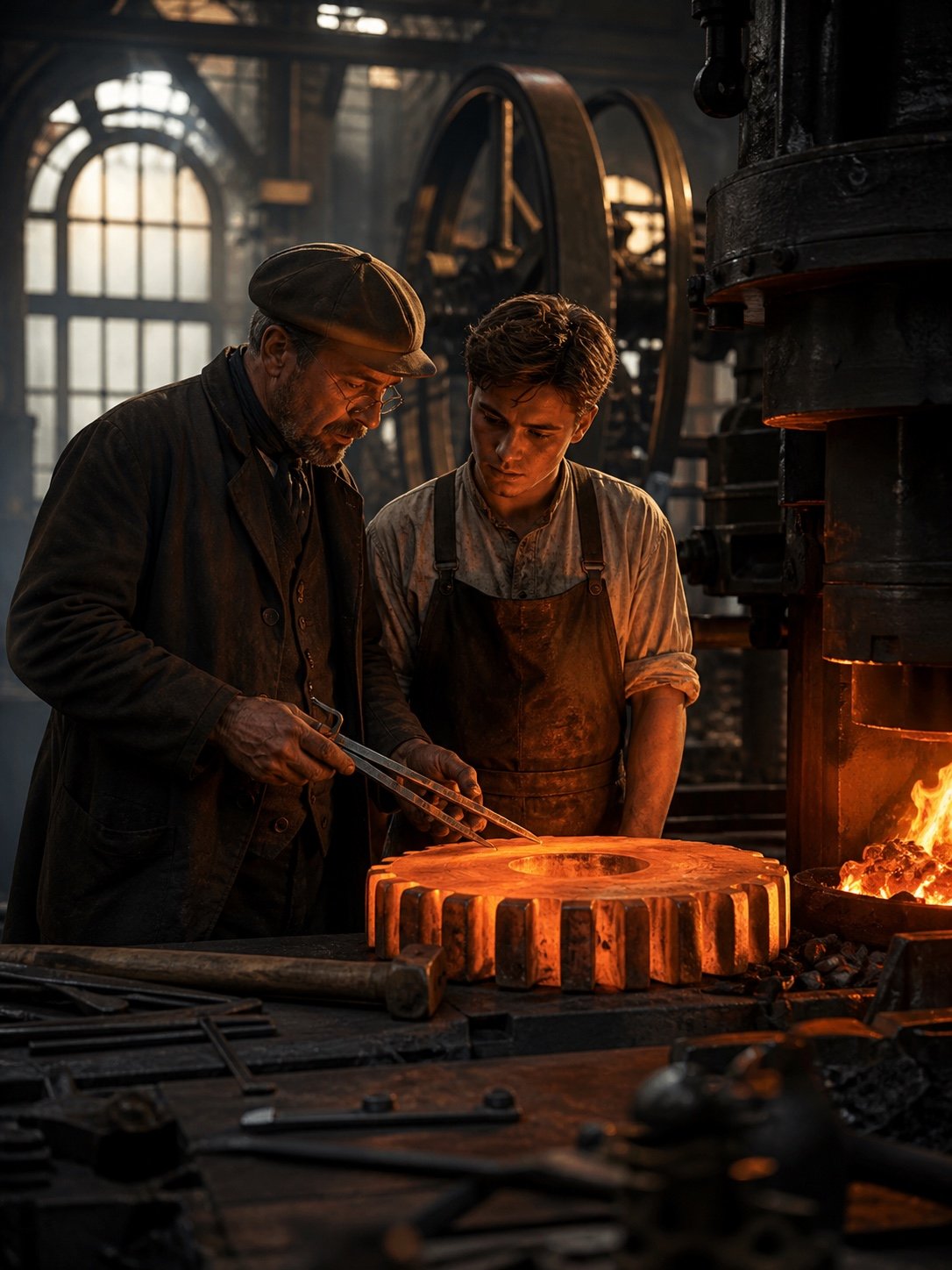
Tools have played a highly important part in the history of civilization.Without tools and the ability to use them, man were indeed but a "poor, bare, forked animal,"—worse clothed than the birds, worse housed than the beaver, worse fed than the jackal."Weak in himself," says Carlyle, "and of small stature, he stands on a basis, at most for the flattest-soled, of some half square foot, insecurely enough; has to straddle out his legs, Jest the very wind supplant him.Feeblest of bipeds!Three quintals are a crushing load for him; the steer of the meadow tosses him aloft like a waste rag.Nevertheless he can use tools, can devise tools: with these the granite mountain melts into light dust before him; he kneads glowing iron as if it were soft paste; seas are his smooth highway, winds and fire his unvarying steeds.Nowhere do you find him without tools: without tools he is nothing; with tools he is all." His very first contrivances to support life were tools of the simplest and rudest construction; and his latest achievements in the substitution of machinery for the relief of the human hand and intellect are founded on the use of tools of a still higher order.
Hence it is not without good reason that man has by some philosophers been defined as A TOOL-MAKING ANIMAL.
Tools, like everything else, had small beginnings. With the primitive stone-hammer and chisel very little could be done. The felling of a tree would occupy a workman a month, unless helped by the destructive action of fire. Dwellings could not be built, the soil could not be tilled, clothes could not be fashioned and made, and the hewing out of a boat was so tedious a process that the wood must have been far gone in decay before it could be launched. It was a great step in advance to discover the art of working in metals, more especially in steel, one of the few metals capable of taking a sharp edge and keeping it. From the date of this discovery, working in wood and stone would be found comparatively easy; and the results must speedily have been felt not only in the improvement of man's daily food, but in his domestic and social condition. Clothing could then be made, the primitive forest could be cleared and tillage carried on; abundant fuel could be obtained, dwellings erected, ships built, temples reared; every improvement in tools marking a new step in the development of the human intellect, and a further stage in the progress of human civilization.
The earliest tools were of the simplest possible character, consisting principally of modifications of the wedge; such as the knife, the shears (formed of two knives working on a joint), the chisel, and the axe.These, with the primitive hammer, formed the principal stock-in-trade of the early mechanics, who were handicraftsmen in the literal sense of the word.But the work which the early craftsmen in wood, stone, brass, and iron, contrived to execute, sufficed to show how much expertness in the handling of tools will serve to compensate for their mechanical imperfections.Workmen then sought rather to aid muscular strength than to supersede it, and mainly to facilitate the efforts of manual skill.Another tool became added to those mentioned above, which proved an additional source of power to the workman.We mean the Saw, which was considered of so much importance that its inventor was honoured with a place among the gods in the mythology of the Greeks.This invention is said to have been suggested by the arrangement of the teeth in the jaw of a serpent, used by Talus the nephew of Daedalus in dividing a piece of wood.
From the representations of ancient tools found in the paintings at Herculaneum it appears that the frame-saw used by the ancients very nearly resembled that still in use; and we are informed that the tools employed in the carpenters' shops at Nazareth at this day are in most respects the same as those represented in the buried Roman city.Another very ancient tool referred to in the Bible and in Homer was the File, which was used to sharpen weapons and implements.Thus the Hebrews "had a file for the mattocks, and for the coulters, and for the forks, and for the axes, and to sharpen the goads." [1] When to these we add the adze, plane-irons, the anger, and the chisel, we sum up the tools principally relied on by the early mechanics for working in wood and iron.
Such continued to be the chief tools in use down almost to our own day. The smith was at first the principal tool-maker; but special branches of trade were gradually established, devoted to tool-making. So long, however, as the workman relied mainly on his dexterity of hand, the amount of production was comparatively limited; for the number of skilled workmen was but small. The articles turned out by them, being the product of tedious manual labour, were too dear to come into common use, and were made almost exclusively for the richer classes of the community. It was not until machinery had been invented and become generally adopted that many of the ordinary articles of necessity and of comfort were produced in sufficient abundance and at such prices as enabled them to enter into the consumption of the great body of the people.
But every improver of tools had a long and difficult battle to fight; for any improvement in their effective power was sure to touch the interests of some established craft. Especially was this the case with machines, which are but tools of a more complete though complicated kind than those above described.
Take, for instance, the case of the Saw. The tedious drudgery of dividing timber by the old fashioned hand-saw is well known. To avoid it, some ingenious person suggested that a number of saws should be fixed to a frame in a mill, so contrived as to work with a reciprocating motion, upwards and downwards, or backwards and forwards, and that this frame so mounted should be yoked to the mill wheel, and the saws driven by the power of wind or water. The plan was tried, and, as may readily be imagined, the amount of effective work done by this machine-saw was immense, compared with the tedious process of sawing by hand.
It will be observed, however, that the new method must have seriously interfered with the labour of the hand-sawyers; and it was but natural that they should regard the establishment of the saw-mills with suspicion and hostility. Hence a long period elapsed before the hand-sawyers would permit the new machinery to be set up and worked. The first saw-mill in England was erected by a Dutchman, near London, in 1663, but was shortly abandoned in consequence of the determined hostility of the workmen. More than a century passed before a second saw-mill was set up; when, in 1767, Mr. John Houghton, a London timber-merchant, by the desire and with the approbation of the Society of Arts, erected one at Limehouse, to be driven by wind. The work was directed by one James Stansfield, who had gone over to Holland for the purpose of learning the art of constructing and managing the sawing machinery. But the mill was no sooner erected than a mob assembled and razed it to the ground. The principal rioters having been punished, and the loss to the proprietor having been made good by the nation, a new mill was shortly after built, and it was suffered to work without further molestation.
Improved methods of manufacture have usually had to encounter the same kind of opposition. Thus, when the Flemish weavers came over to England in the seventeenth century, bringing with them their skill and their industry, they excited great jealousy and hostility amongst the native workmen. Their competition as workmen was resented as an injury, but their improved machinery was regarded as a far greater source of mischief. In a memorial presented to the king in 1621 we find the London weavers complaining of the foreigners' competition, but especially that "they have made so bould of late as to devise engines for working of tape, lace, ribbin, and such like, wherein one man doth more among them than 7 Englishe men can doe; so as their cheap sale of commodities beggereth all our Englishe artificers of that trade, and enricheth them." [2]
At a much more recent period new inventions have had to encounter serious rioting and machine-breaking fury.Kay of the fly-shuttle, Hargreaves of the spinning-jenny, and Arkwright of the spinning-frame, all had to fly from Lancashire, glad to escape with their lives.Indeed, says Mr.Bazley, "so jealous were the people, and also the legislature, of everything calculated to supersede men's labour, that when the Sankey Canal, six miles long, near Warrington, was authorized about the middle of last century, it was on the express condition that the boats plying on it should be drawn by men only!" [3] Even improved agricultural tools and machines have had the same opposition to encounter; and in our own time bands of rural labourers have gone from farm to farm breaking drill-ploughs, winnowing, threshing, and other machines, down even to the common drills,—not perceiving that if their policy had proved successful, and tools could have been effectually destroyed, the human race would at once have been reduced to their teeth and nails, and civilization summarily abolished.
[4] It is, no doubt, natural that the ordinary class of workmen should regard with prejudice, if not with hostility, the introduction of machines calculated to place them at a disadvantage and to interfere with their usual employments; for to poor and not very far-seeing men the loss of daily bread is an appalling prospect.But invention does not stand still on that account.Human brains WILL work.Old tools are improved and new ones invented, superseding existing methods of production, though the weak and unskilled may occasionally be pushed aside or even trodden under foot.The consolation which remains is, that while the few suffer, society as a whole is vastly benefitted by the improved methods of production which are suggested, invented, and perfected by the experience of successive generations.
The living race is the inheritor of the industry and skill of all past times; and the civilization we enjoy is but the sum of the useful effects of labour during the past centuries. Nihil per saltum. By slow and often painful steps Nature's secrets have been mastered. Not an effort has been made but has had its influence. For no human labour is altogether lost; some remnant of useful effect surviving for the benefit of the race, if not of the individual. Even attempts apparently useless have not really been so, but have served in some way to advance man to higher knowledge, skill, or discipline. "The loss of a position gained," says Professor Thomson, "is an event unknown in the history of man's struggle with the forces of inanimate nature." A single step won gives a firmer foothold for further effort. The man may die, but the race survives and continues the work,—to use the poet's simile, mounting on stepping-stones of dead selves to higher selves.
Philarete Chasles, indeed, holds that it is the Human Race that is your true inventor: "As if to unite all generations," he says, "and to show that man can only act efficiently by association with others, it has been ordained that each inventor shall only interpret the first word of the problem he sets himself to solve, and that every great idea shall be the RESUME of the past at the same time that it is the germ of the future." And rarely does it happen that any discovery or invention of importance is made by one man alone.The threads of inquiry are taken up and traced, one labourer succeeding another, each tracing it a little further, often without apparent result.This goes on sometimes for centuries, until at length some man, greater perhaps than his fellows, seeking to fulfil the needs of his time, gathers the various threads together, treasures up the gain of past successes and failures, and uses them as the means for some solid achievement, Thus Newton discovered the law of gravitation, and thus James Watt invented the steam-engine.So also of the Locomotive, of which Robert Stephenson said, "It has not been the invention of any one man, but of a race of mechanical engineers.
" Or, as Joseph Bramah observed, in the preamble to his second Lock patent, "Among the number of patents granted there are comparatively few which can be called original so that it is difficult to say where the boundary of one ends and where that of another begins."
The arts are indeed reared but slowly; and it was a wise observation of Lord Bacon that we are too apt to pass those ladders by which they have been reared, and reflect the whole merit on the last new performer.Thus, what is hailed as an original invention is often found to be but the result of a long succession of trials and experiments gradually following each other, which ought rather to be considered as a continuous series of achievements of the human mind than as the conquest of any single individual.It has sometimes taken centuries of experience to ascertain the value of a single fact in its various bearings.Like man himself, experience is feeble and apparently purposeless in its infancy, but acquires maturity and strength with age.Experience, however, is not limited to a lifetime, but is the stored-up wealth and power of our race.Even amidst the death of successive generations it is constantly advancing and accumulating, exhibiting at the same time the weakness and the power, the littleness and the greatness of our common humanity.
And not only do we who live succeed to the actual results of our predecessors' labours,—to their works of learning and of art, their inventions and discoveries, their tools and machines, their roads, bridges, canals, and railways,—but to the inborn aptitudes of blood and brain which they bequeath to us, to that "educability," so to speak, which has been won for us by the labours of many generations, and forms our richest natural heritage.
The beginning of most inventions is very remote. The first idea, born within some unknown brain, passes thence into others, and at last comes forth complete, after a parturition, it may be, of centuries. One starts the idea, another developes it, and so on progressively until at last it is elaborated and worked out in practice; but the first not less than the last is entitled to his share in the merit of the invention, were it only possible to measure and apportion it duly. Sometimes a great original mind strikes upon some new vein of hidden power, and gives a powerful impulse to the inventive faculties of man, which lasts through generations. More frequently, however, inventions are not entirely new, but modifications of contrivances previously known, though to a few, and not yet brought into practical use. Glancing back over the history of mechanism, we occasionally see an invention seemingly full born, when suddenly it drops out of sight, and we hear no more of it for centuries. It is taken up de novo by some inventor, stimulated by the needs of his time, and falling again upon the track, he recovers the old footmarks, follows them up, and completes the work.
There is also such a thing as inventions being born before their time—the advanced mind of one generation projecting that which cannot be executed for want of the requisite means; but in due process of time, when mechanism has got abreast of the original idea, it is at length carried out; and thus it is that modern inventors are enabled to effect many objects which their predecessors had tried in vain to accomplish.As Louis Napoleon has said, "Inventions born before their time must remain useless until the level of common intellects rises to comprehend them." For this reason, misfortune is often the lot of the inventor before his time, though glory and profit may belong to his successors.Hence the gift of inventing not unfrequently involves a yoke of sorrow.Many of the greatest inventors have lived neglected and died unrequited, before their merits could be recognised and estimated.Even if they succeed, they often raise up hosts of enemies in the persons whose methods they propose to supersede.
Envy, malice, and detraction meet them in all their forms; they are assailed by combinations of rich and unscrupulous persons to wrest from them the profits of their ingenuity; and last and worst of all, the successful inventor often finds his claims to originality decried, and himself branded as a copyist and a pirate.